 Anatopus
Why You Can't Tickle Yourself
Every line of this video with the sources behind it. The script was written from the 7 sources below and checked by a human; the visuals and voices are made with AI tools.
 Watch the video on YouTube
Sources
- S1Blakemore, Wolpert & Frith (2000). "Why can't you tickle yourself?" NeuroReport, 11(11):R11–R16. PubMed 10943682 · PDF
ReviewUsed for: The 1971 foot study, efference copy and forward model, brain scans, the cerebellum, the robot delay and rotation study, the eyeball nudge, telling your own movements from the world's
Cited at 0:00 0:58 1:30 1:43 2:02 2:18 2:34 3:16 3:42 4:07 4:24 6:07
- S2Selden (2004). "Tickle". Journal of the American Academy of Dermatology, 50(1):93–97. PubMed 14699372
ReviewUsed for: Knismesis and gargalesis
Cited at 0:21
- S3Wolpert & Flanagan (2001). "Motor prediction". Current Biology, 11(18):R729–R732. PubMed 11566114 · PDF
Review (primer)Used for: Efference copy, forward model, the eyeball nudge, the ketchup bottle grip
- S4Bays & Wolpert (2007). "Computational principles of sensorimotor control that minimize uncertainty and variability". Journal of Physiology, 578(2):387–396. PMC2075158
ReviewUsed for: Sensory cancellation, force overestimation and the joystick control, the cerebellum, self-other distinction
- S5Shergill, Bays, Frith & Wolpert (2003). "Two eyes for an eye: the neuroscience of force escalation". Science, 301(5630):187. DOI
Primary study, supporting S4 and S6Used for: The paired pressing game and the paper's title; no figures from it are quoted
- S6Kilteni (2025). "The extraordinary enigma of ordinary tickle behavior: why gargalesis still puzzles neuroscience". Science Advances, 11:eadt0350. PMC12101506
ReviewUsed for: Knismesis can be self-induced and gargalesis can't, 98% of people (315 of 322) attenuate self-touch, the consensus and its open gap (studies used gentle touch, not gargalesis), overshoot on self-generated force, Darwin's view of tickle
- S7Darwin, C. (1872). The Expression of the Emotions in Man and Animals, ch. VIII. Public domain. Project Gutenberg
Historical quoteUsed for: The Darwin quote, word for word with one cut marked by an ellipsis
Script
0:00Can you tickle yourself?
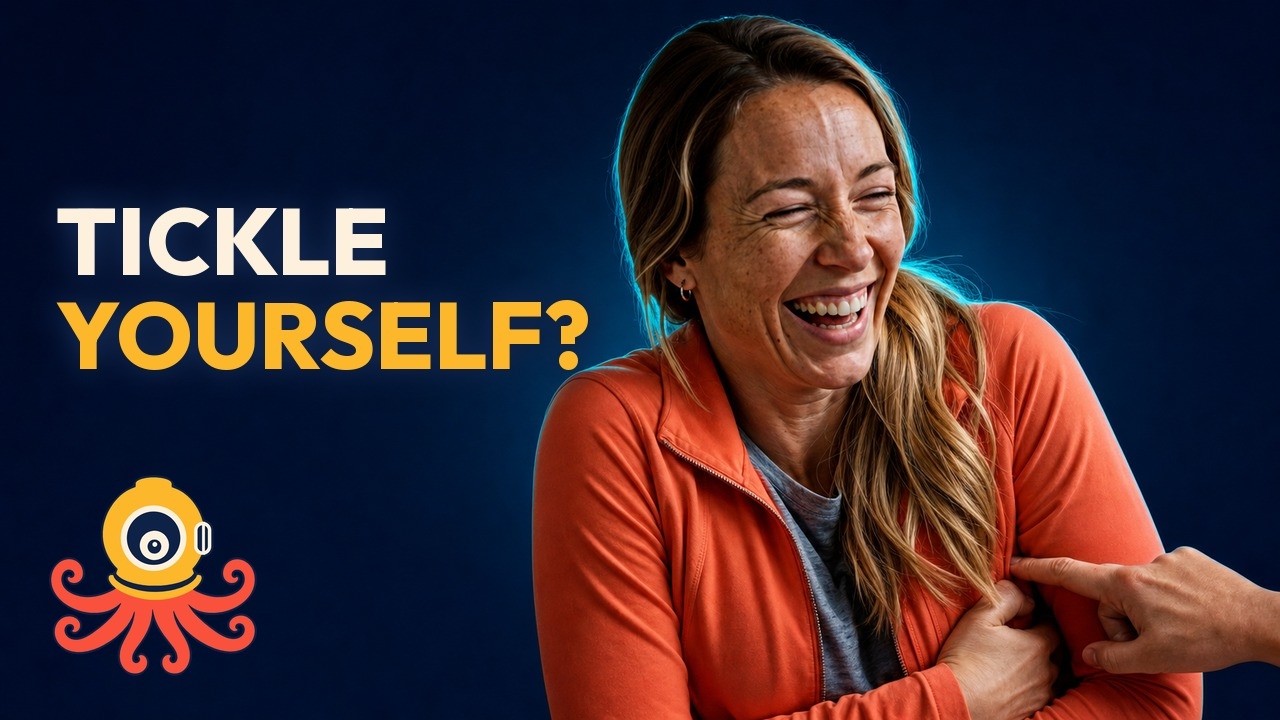
Go ahead: try to tickle yourself. Nothing, right? Let a friend do the exact same thing, and you squirm. Same touch. The difference? Your brain saw yours coming, and turned it down before it landed.S1
0:20Why this is weird
Tickling is stranger than it looks. Scientists even split it in two. There's the light, feathery tickle, like a bug crawling on your arm, called knismesis. And the heavy, poke-in-the-ribs tickle that makes you laugh, called gargalesis.S2S6
The feathery kind you can partly give yourself. The laughing kind is the one that's so hard to self-induce, and that's our mystery.S6
“From the fact that a child can hardly tickle itself … it seems that the precise point to be touched must not be known.”S7Charles Darwin, 1872
A good guess, and it took another century to test it. In 1971, researchers stroked people's feet. When volunteers did it to themselves, it barely tickled. When the experimenter did it, it tickled a lot. And here's the curious part: when the experimenter moved the volunteer's own hand to do the tickling, the result landed somewhere in between.S1
So it isn't mostly about whose hand touches you. It's about who decided to move it.
1:30How it works
Every time you move, your brain sends a command down to your muscles. But it doesn't send just one. It keeps a copy for itself. Scientists call it an efference copy.S1S3
That copy is a heads-up. It lets your brain run a quick simulation: if my hand moves like this, what should I feel? Neuroscientists call this simulation a forward model. It's a prediction of the sensation, made before the sensation arrives.S1S3
Then the real touch arrives from your skin, and your brain compares it with the prediction. If they match, the brain treats that touch as old news and turns it down. In lab tests, 98 percent of people feel their own touch as weaker.S1S4S6
You can see this in brain scans. When a touch is self-made, two areas respond less: part of the brain's touch cortex, and a region called the anterior cingulate, which is tied to how intense and pleasant a sensation feels.S1
And the prediction itself? The prime suspect is the cerebellum, the wrinkled structure at the back of your brain best known for coordinating movement. It seems to know which movements will produce which touch, and to send the signal that dials your own touch down.S1S4
A tickle from someone else comes with no copy, no prediction, and nothing to cancel. So it arrives at full strength.
Most scientists agree this is the likeliest reason you can't tickle yourself. But here's an honest footnote: the brain-scan studies used gentle strokes and taps, not the full, laughing tickle. That final piece is still being tested.S6
Why would a brain go to all this trouble? Because you touch yourself all day long. Your clothes brush your skin, your fingers touch your face, your arms rub your sides. By muting the touches it can predict, your brain makes the ones it can't predict stand out. And the unpredicted ones are usually the ones that matter, like something crawling on your skin.S1S4
Your eyes play a similar trick. Your brain predicts where your eyes will point each time it moves them, so the world holds still. But nudge an eyeball gently from the outside, through the eyelid, and the world seems to jump, because that movement came with no prediction.S1S3
4:00The robot twist
So if tickling really comes down to prediction, you should be able to tickle yourself by breaking the prediction.
That's what researchers in London did. Volunteers moved a handle with one hand. A robot copied the movement and brushed a piece of soft foam across the palm of their other hand. With no delay, it felt like tickling yourself: not much.S1
Then the scientists added a delay. A tenth of a second. Two tenths. Three. As the delay grew to a fifth of a second, the same stroke felt more and more tickly. Tilting the direction of the stroke did the same.S1
Your own hand, your own movement, just a fifth of a second late, and your brain no longer counts it as yours. The prediction isn't a vague "I'm moving". It's precise to a fraction of a second.
4:56Why it matters
This isn't just a party fact. Turning down your own touch changes how you act.
“Now press on that finger yourself, with exactly the same force.”S4S5Task instruction, reconstructed
They used a finger of their other hand, and they consistently pressed too hard. Their own push felt weaker than it really was, so they overshot. When they set the force with a joystick instead, the overshoot mostly vanished.S4S6
Now picture two people trading pushes, each trying to give back exactly what they got. Each one overshoots, so the pushes keep growing, and both sides honestly feel they're only matching. When researchers tried this in the lab, that's what happened. They called their paper "Two eyes for an eye".S5
The same prediction keeps your grip steady. Smack the bottom of a ketchup bottle with one hand, and the fingers holding it tighten at the exact moment of the smack, not a beat later. If someone else smacks it, your grip lags behind.S3
6:13Outro
So the next time you can't tickle yourself, don't blame your fingers. It's your brain, a step ahead of you, quietly editing out the one person it always sees coming: you.
